




The reason why women's suit jackets can last forever in the market and are deeply loved by consumers is not only because of the tailoring and style, but also because of the blessing of materials and craftsmanship. For suppliers, in-depth understanding of the application and finished product effects of different fabrics, as well as the advantages in details and craftsmanship, is the key to increasing product added value and winning brand favor.
The choice of fabric is the basic support for the texture and grade of a suit jacket. High-end models often use wool or cashmere materials, which are soft to the touch and warm, especially suitable for autumn and winter styles, showing a crisp and warm elegant temperament. Woolen fabrics are very common in the autumn and winter market because of their thickness, good molding, and suitability for three-dimensional modeling. For spring and summer, linen or silk blended fabrics become light and breathable choices, suitable for creating casual commuter jackets with natural drape. Polyester blends are a cost-effective solution that takes into account both crispness and wear resistance, suitable for basic business models and large-scale commuter products.
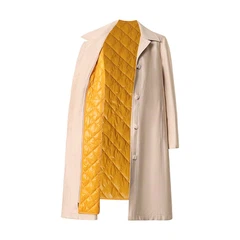
In terms of lining treatment, truly excellent women's suit jackets are often equipped with comfortable, breathable and delicate lining fabrics. Acetate fiber, polyester lining and other materials are commonly used, which are not only easy to put on and take off, but also improve the overall fit, avoiding wrinkles, heat accumulation and other discomforts when wearing. For brand customers, these seemingly hidden craftsmanship details are precisely the key to determining the repurchase rate.
Three-dimensional tailoring is the technological highlight that truly distinguishes women's suit jackets from ordinary jackets. Through the precise layout of the front dart, the back cutting line, the chest dart and the waist dart, the whole garment fits the female body better, modifies the shoulder line, tightens the waist, and presents a natural and smooth outline. This not only requires suppliers to have good pattern making capabilities, but also tests the degree of coordination between fabrics and craftsmanship.
Polishing on details is an "invisible label" that reflects quality. For example, are the buttons made of real horns or metal custom models? Is it reinforced with double-row stitching? Is the pocket line smooth and does the design take into account actual use? Is the collar type a classic pointed collar, a French lapel or a simple collarless collar? These seemingly minor details after the garment is formed are actually the source of consumers' first impression of "good quality".
In short, the material and craftsmanship of women's suit jackets are the foundation of their style expression, wearing experience and brand value. If suppliers can make full efforts from fabrics, tailoring, lining to detail design, they can not only improve the market recognition of products, but also establish a "professional, reliable and trustworthy" brand image in the minds of customers. After all, a suit jacket that really impresses people often hides a lot of "unobtrusive intentions".